ABC-Development VSLAs Drive Improved Household Nutrition and Financial Inclusion in Kambia and Port Loko Districts

For many families, improving nutrition depends on more than knowing which foods are healthy. Households also need the financial resources, planning skills and livelihood opportunities to access nutritious foods consistently.
Recognizing this connection, ABC-Development is using Village Savings and Loan Associations (VSLAs) as practical platforms to strengthen financial inclusion, improve household nutrition and build community resilience in Kambia and Port Loko Districts.
This work is supported by Trócaire, the Irish Civil Society Partnership (ICSP), and The Church of Jesus Christ of Latter-day Saints, working alongside community structures, local authorities and other stakeholders to strengthen sustainable, community-led solutions.
Through its community-based programming, ABC-Development has integrated nutrition education, household budgeting and savings into existing VSLA structures. The approach recognizes that VSLAs are more than savings and lending groups. They are trusted community platforms where members meet regularly, share experiences, make financial decisions and take collective action to address challenges affecting their households.
The intervention has reached 538 beneficiaries, including 338 women and 200 men, with 50 adolescent girls reached where youth data were available. Four VSLAs have been supported alongside leadership training, community dialogues, mentoring and coaching sessions designed to strengthen participation, leadership and community ownership.
Nutrition and household budgeting sessions have helped VSLA members understand the relationship between financial decisions and family nutrition. Participants are encouraged to consider how regular savings can be used not only for emergencies and household expenses, but also to support food production, diversify diets and invest in activities that can improve livelihoods.
One of the strongest examples of this approach is the establishment of community nutrition gardens by VSLA members.
Following nutrition and household budgeting training, groups developed their own action plans and mobilized their savings, labour and locally available resources to establish gardens. Members prepared land and planted crops including okra, cucumber and pepper.
The gardens provide an opportunity to increase access to nutritious locally produced foods while creating potential opportunities for income generation.
Importantly, members demonstrated strong ownership by contributing their own labour and resources rather than relying entirely on external material support. This illustrates how financial literacy and nutrition education can motivate communities to develop practical solutions using resources available within their own communities.
The experience demonstrates that communities can move from receiving information to taking action when they have the knowledge, confidence and platforms needed to make decisions collectively.
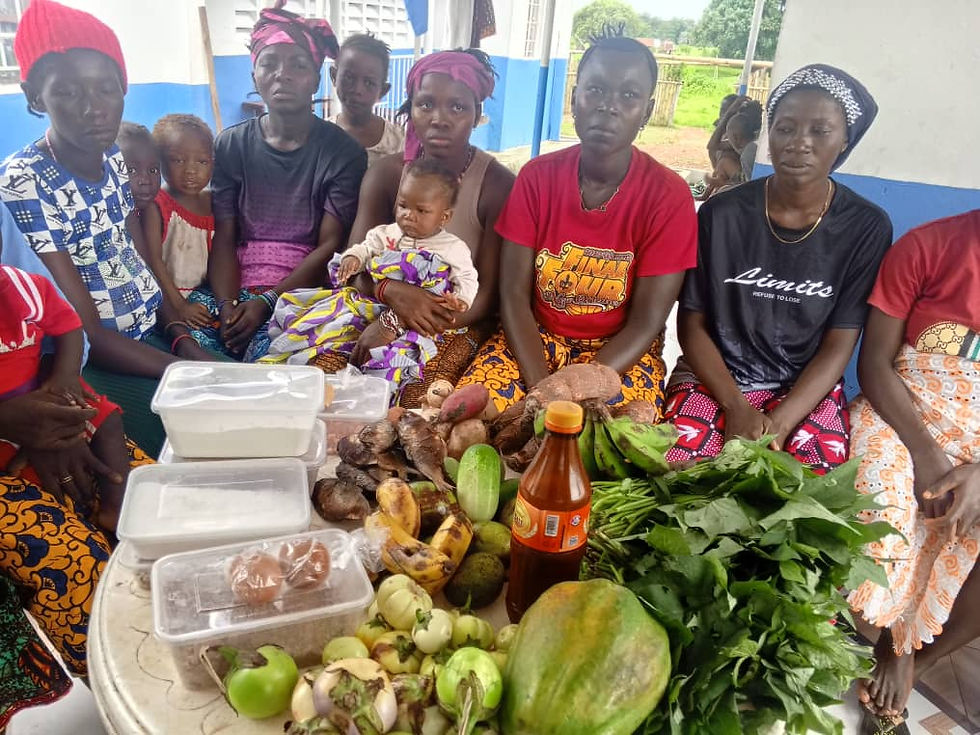
Women remain central to the success of the VSLA approach. With 338 women reached, the project is creating opportunities for women to strengthen their financial knowledge, participate in group decision-making and contribute to household nutrition and livelihood decisions.
Women's group meetings also provide a space for members to discuss savings, household budgeting, food choices and practical ways of improving family wellbeing. These conversations create opportunities for peer learning and help reinforce positive nutrition practices.
Leadership development is another important component of the intervention. Two leadership training sessions have been conducted, helping community members strengthen their capacity to organize activities, manage groups and support collective action.
The project has invested in community engagement through four community dialogue sessions and ten community meetings. These platforms provide opportunities for communities to discuss challenges, identify priorities and develop locally appropriate responses.
In addition, six mentoring and coaching sessions and three monitoring visits have supported implementation. These activities provide opportunities to identify challenges, reinforce learning and strengthen community-led initiatives.
The project has also awarded eight community grants, with a total of 50,000 invested in community grants and project activities. These investments complement community savings and contributions and support activities that can contribute to improved household wellbeing and resilience.
The combination of community grants, savings mechanisms, training and mentoring is helping create an enabling environment in which community members can take greater responsibility for their own development priorities.
An important feature of the approach is the continued integration of nutrition and household budgeting discussions into routine VSLA meetings.
Rather than treating nutrition as a one-time training topic, members are encouraged to continue discussing healthy diets, food production, savings and household financial decisions during their regular meetings.
This creates an opportunity for members to share experiences, encourage one another and reinforce positive practices. It also provides a practical and sustainable way of maintaining nutrition education without creating additional community structures.
The approach is particularly valuable because peer learning allows members to discuss practical experiences using locally available foods and resources. Participants can learn from one another about food production, budgeting and ways of improving household diets within their own circumstances.
The progress being made through VSLAs reflects the importance of strong partnerships in community development.
ABC-Development provides the implementation platform and works directly with communities to strengthen capacity, facilitate training, support community action and monitor progress.
Trócaire, the Irish Civil Society Partnership (ICSP), and The Church of Jesus Christ of Latter-day Saints provide important funding and support that enable community-level activities to take place and help strengthen the wider programme's contribution to household wellbeing and resilience.
The involvement of local authorities, Ministry of Gender representatives and other community stakeholders further strengthens coordination and promotes local ownership.
Together, these partnerships help create the conditions for communities to identify their own priorities, mobilize available resources and implement practical solutions.
The experience demonstrates that financial inclusion and nutrition can be addressed together through existing community structures.
VSLAs provide an effective entry point because members already have a culture of saving, collective decision-making and mutual support. When nutrition education is combined with household budgeting, members are better positioned to consider how their financial decisions can contribute to healthier diets and stronger household food security.
Several lessons are emerging.
First, existing VSLAs can provide an effective platform for nutrition education because members already meet regularly and have established relationships of trust.
Second, linking nutrition with household budgeting helps families see nutritious food as an investment, rather than simply a health issue.
Third, community-led action strengthens ownership. When groups identify their own priorities and contribute their own labour and resources, they develop a stronger sense of responsibility for the outcomes.
Finally, integrating nutrition discussions into routine VSLA meetings provides a practical and low-cost approach for reinforcing learning and encouraging continued positive practices.
Although the results are still emerging, the experience provides encouraging evidence of how VSLAs can contribute to both financial inclusion and improved household nutrition.
For ABC-Development, the experience reinforces a simple but important lesson:
Improving nutrition is not only about what families know—it is also about what families are empowered and financially equipped to do.
By bringing savings, household budgeting, nutrition education and collective action together, VSLAs are helping communities build stronger foundations for healthier households, greater financial resilience and improved livelihoods.
With the support of Trócaire, Irish Aid, and The Church of Jesus Christ of Latter-day Saints, ABC-Development and its community partners are demonstrating how locally led action can turn knowledge into practical solutions.
The experience offers an important lesson for future programming: when communities have access to knowledge, trusted structures, financial mechanisms and supportive partnerships, they can lead initiatives that have the potential to improve nutrition, strengthen livelihoods and build more resilient families.


Comments